
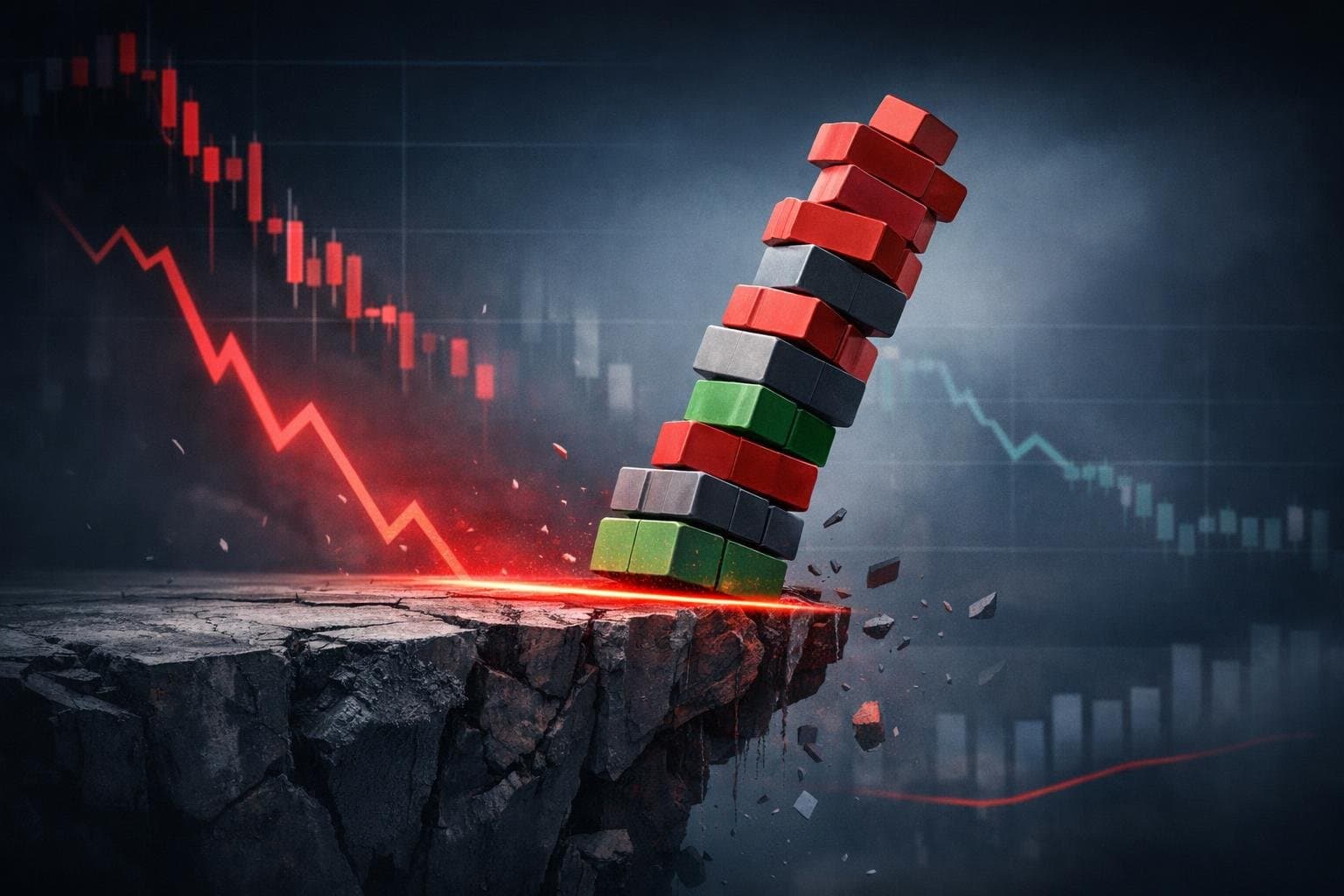
The Allure and Danger of Leverage
Leverage trading allows you to control a larger position than your actual capital would allow. With 10x leverage, for example, a $1,000 investment controls $10,000 worth of cryptocurrency. This sounds attractive—until you realize losses are amplified the same way.
How Leverage Actually Works
When you open a leveraged position, you're essentially borrowing money from the exchange to increase your buying power. This borrowed money isn't free; you're charged funding rates and face liquidation if the market moves against you.
The Math of Liquidation
With 10x leverage, a mere 10% move against your position wipes out your entire investment. At 50x leverage (common on some exchanges), just a 2% adverse movement liquidates you completely.
Example:
- You have $1,000 and use 20x leverage
- Your position is worth $20,000
- If the price drops just 5%, you lose $1,000 (your entire investment)
- This happens in minutes during volatile market conditions
Why Most Leveraged Traders Fail
1. Volatility is Underestimated
Cryptocurrency markets regularly see 10-20% daily swings. What feels like a small position can be liquidated within hours during normal market volatility.
2. Emotional Decision Making
Leverage amplifies not just gains and losses, but emotions. Traders make increasingly poor decisions as they watch their positions approach liquidation.
3. Funding Rate Costs
Holding leveraged positions costs money through funding rates. Over time, these fees eat into profits and accelerate losses.
4. Revenge Trading
After being liquidated, many traders deposit more money and take even higher-risk positions to "win back" their losses. This cycle destroys portfolios.
If You Must Use Leverage
We strongly recommend beginners avoid leverage entirely. However, if you choose to use it:
- Never exceed 2-3x leverage under any circumstances
- Use stop-losses religiously to limit potential losses
- Risk only 1-2% of your portfolio on any single trade
- Understand funding rates before opening positions
- Accept that you will have losing trades and plan accordingly
A Safer Alternative
Instead of leveraged trading, consider:
- Spot trading with proper position sizing
- Dollar-cost averaging into positions over time
- Long-term holding of fundamentally sound projects
- Paper trading to test strategies without real money
The Hidden Costs New Traders Miss
Liquidation is not the only risk. Leveraged positions can become expensive even when the market moves sideways. Funding rates, trading fees, spreads, and slippage all reduce your margin for error. A strategy that looks profitable on a chart can perform poorly after these costs are included.
Funding rates are especially important in perpetual futures. When many traders are positioned in the same direction, one side of the market pays the other. Holding a position for days or weeks can quietly drain capital, particularly during crowded bullish or bearish periods. New traders often focus only on entry and exit prices and ignore the carrying cost of the position.
Slippage matters during fast moves. A stop-loss order is not a guarantee that you will exit at the exact stop price. In thin markets or panic conditions, the execution price can be worse than expected. This is one reason high leverage is dangerous in smaller tokens where liquidity is limited.
A Pre-Trade Risk Checklist
Before opening any leveraged position, write down the trade plan. If you cannot write it clearly, the setup is probably not ready.
A basic plan should include:
- Entry reason – the specific signal or setup, not a feeling.
- Invalidation point – the price level where the idea is wrong.
- Position size – calculated from maximum acceptable loss.
- Stop-loss level – placed before entering the trade.
- Exit plan – where partial or full profits will be taken.
- Maximum daily loss – the point where trading stops for the day.
The maximum daily loss rule is important. Many large losses happen after the first losing trade, when a trader tries to win the money back quickly. A written stop for the day protects you from emotional escalation.
Why Lower Leverage Still Requires Discipline
Using 2x or 3x leverage is safer than using 20x, but it is not automatically safe. A poorly sized 3x position can still damage a portfolio if the trader adds to losers, ignores stops, or holds through major news events without a plan.
Beginners should also avoid trading immediately before major macro announcements, exchange listings, token unlocks, or project-specific news. These events can create sudden price moves that overwhelm normal technical setups. If you do not understand why volatility may increase, staying out is a valid risk management choice.
Educational Use vs. Portfolio Building
Some traders use small leveraged positions as a learning exercise, but that should be treated as tuition, not income. Keep the amount small enough that a total loss will not affect your rent, savings, tax obligations, or long-term investment plan. If a trade needs to work for your finances to be okay, the trade is already too large.
For most people, the better path is to build knowledge with spot positions, paper trading, and a written journal. A trading journal should record why you entered, how you felt, whether you followed your plan, and what the result was. Over time, this shows whether the strategy has an edge or whether wins are coming from luck.
Signals to Stop Trading
Knowing when not to trade is part of risk management. Stop for the day if you ignore a stop-loss, increase leverage after a loss, trade because of anger or boredom, or open a position without writing down the invalidation level. These are process failures, not normal market losses.
Also stop if you do not understand why the price is moving. Crypto markets can react quickly to exchange outages, liquidation cascades, regulatory headlines, token unlocks, and macroeconomic news. Sitting out during unclear conditions protects capital and gives you time to learn what happened without paying for the lesson through a forced liquidation.
Conclusion
Leverage trading in cryptocurrency is extremely risky because a small market move can erase the margin behind a position. Before you use leverage, ask whether the trade has a written plan, whether the loss is affordable, and whether spot exposure would achieve the goal with less risk.
If you're serious about building wealth in crypto, focus on education, patience, and capital preservation rather than trying to get rich quick through leverage.